
The questions that arrive after a display order has been placed are rarely about the panel. They are about what happens between the signed confirmation and the moment the site is running: which stage the goods are actually at, what will be inspected and by whom, how the units will be packed for a sea freight leg, which documents travel with the shipment, what happens if a unit fails in month four, and who holds the parts to repair it. Most of these can be answered before the order is placed, and the answers are cheaper to agree in advance than to negotiate after a fault appears. This FAQ sets out the route from order confirmation to a production slot, what happens during production and inspection, how packing and shipping documentation are prepared, how the spare parts and support model should be agreed, and what a buyer should hold at the end of a project.
From order confirmation to a production slot
Production does not start with the purchase order alone. It starts when three things exist together: a signed confirmation that fixes the price and the trade terms, a frozen configuration, and the payment that releases material purchasing. The frozen configuration is the document that matters most, because it is the version the factory will build and the version the buyer will inspect against. Anything not settled at that point becomes a change order later, and a change order consumes schedule in a way that a longer initial review does not.
Two items are worth settling at this stage even when they feel premature. The first is the approved sample and its signed record, because a sample that is not documented as a reference is only a demonstration unit. The second is a serial number range or numbering rule for the batch, which makes everything that follows traceable, from the inspection report to the warranty claim. Where a custom enclosure is involved, tooling has its own lead time before the first production unit can exist, and that lead time should be stated in weeks rather than assumed to run in parallel with everything else.
| Milestone | What becomes fixed | What it depends on |
|---|---|---|
| Order confirmation and deposit | Price, trade terms and the quantity released for material purchasing | The signed confirmation and the buyer's payment route |
| Configuration freeze | Specification, option set, branding and packaging | The technical proposal agreed at the sample stage |
| Tooling release, where a custom enclosure is involved | Enclosure dimensions, finish and interface positions | Approved drawings and the tooling lead time |
| Production slot | The week in which the batch is built | Material availability, tooling readiness and the confirmed deposit |
| Inspection and release | That the batch meets the acceptance criteria | The agreed inspection plan and the approved sample |
What happens during production and inspection
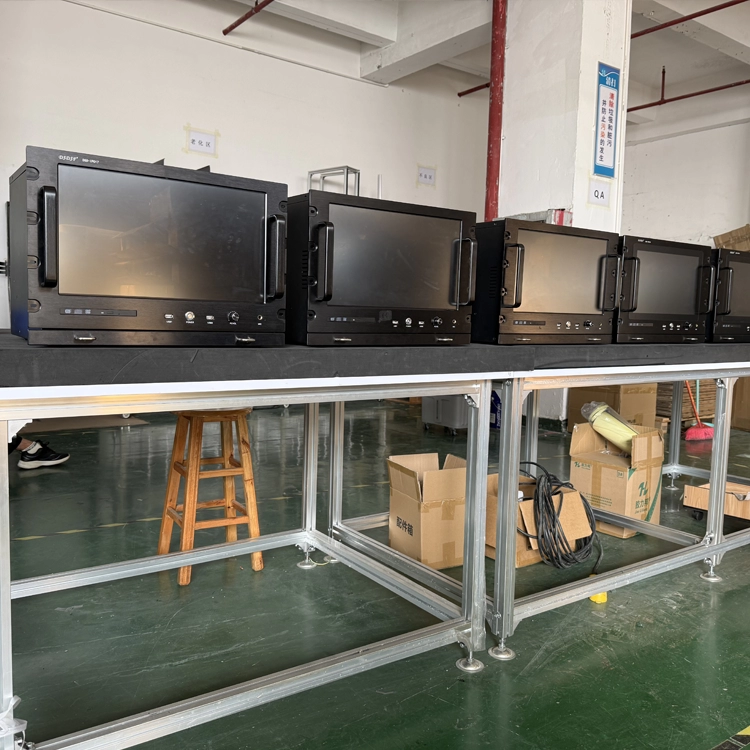
A structured production route for display hardware runs through four checkpoints, and a buyer who knows them can ask for evidence rather than reassurance at each one. The first is incoming material control, which covers the panel, the mainboard, the power supply and the enclosure parts against the approved specification. The second is the first article inspection, where a unit built with production tooling and production processes is measured and tested against the frozen specification before the line continues. This step exists because tooling behaves differently from a prototype, and it is the earliest point at which a dimensional or cosmetic deviation can be caught cheaply. The third is in-line inspection during assembly and after sealing, covering appearance, fit, hardware function, touch calibration where applicable and software load. The fourth is the final inspection on the finished, packed goods against the acceptance criteria set for the order, together with the aging test.
The aging test is the checkpoint buyers most often omit and most often regret, particularly where units run continuously. A display intended for 24 hour operation in a public space should be run before packing for a period agreed with the factory, precisely because the failures that matter are early-life failures in the power supply and the backlight driving circuit. Where a buyer wants an independent view, a third-party inspection before shipment is normally arranged on a sampling basis against the same acceptance criteria, and it works best when that criterion was written before the first unit was built rather than after the first complaint.
The acceptance criteria document is what makes an inspection meaningful, and it is worth drafting before the first unit is built. It should state the defect definitions that apply, the sampling plan used on the finished goods, which properties are measured and which are judged visually, the cosmetic standard that applies to the parts of the enclosure that will remain visible after installation, and the point at which a deviation becomes a rejection rather than a concession. Where the product is supplied against an international standard, the criteria should name that standard and the revision it was read from, so that a later revision does not silently change what was agreed, which is the practical reason standards are versioned rather than treated as a single fixed description of a product (International Electrotechnical Commission, What Are Standards, retrieved 29 September 2026). A criterion written after the first complaint is a negotiation — a criterion agreed before production is a measurement (International Organization for Standardization, ISO 9001 Quality Management, retrieved 29 September 2026).
Packing, loading and the documents that travel with the goods
Packing specification should follow the shipping mode, not the product alone. A unit moving by air within one continent can travel in a carton with foam end caps and internal corner protection. The same unit moving by sea, transhipped twice and stored in a container yard, needs the corner protection, the moisture barrier, a stronger outer carton and, for large panels, video wall sections and glass-fronted kiosks, a wooden crate with a braced frame. Because solid wood packaging is subject to phytosanitary rules in many markets, treated wood carrying the international mark is the safe default for any international shipment, and the packing list should state the treatment, because a shipment held at the border for untreated wood costs more in demurrage than the crate ever saved.
Container loading is worth planning rather than leaving to the forwarder. Large panels loaded flat and stacked beyond the recommended figure deform under their own weight over a long sea leg, and a mixed container holding kiosks, panels and accessories has to be sequenced so that the heavy crates are not resting on cartons. Where a video wall is shipped as a project, the loading plan should keep the panels for one wall together, because a wall assembled from panels out of two different production batches can show a visible difference in colour and brightness that no amount of calibration fully removes.
Classification and valuation sit alongside the packing on the same invoice. Display units fall under heading 8528 of the harmonised system, and the exact subheading follows the display technology and whether the unit can connect to an automatic data processing machine, so the description on the invoice should be written to match the goods rather than copied from a previous shipment of a different model (World Customs Organization, Trade Tools, retrieved 29 September 2026).
| Document | Purpose and who prepares it |
|---|---|
| Commercial invoice | Declares value, model and terms of sale for customs; prepared against the confirmed order |
| Packing list | States cartons, weights, dimensions and wood treatment; the basis of customs inspection and of any damage claim |
| Bill of lading or air waybill | Contract of carriage and title document; issued by the carrier |
| Certificate of origin | Supports tariff treatment and origin declaration; issued by a chamber of commerce |
| Serial number list | Links each unit in the shipment to the batch and the inspection record; the basis of warranty administration |
| Loading plan and photographs | Evidence of condition at loading; the first thing an insurer asks for after transit damage |
The loading photographs are the single cheapest protection a buyer can ask for. A set of images showing the crates in the container as loaded, with the container number visible, settles most transit damage arguments before they begin, because the alternative is reconstructing an event that happened weeks earlier in a port nobody visited.
When something changes after the order is confirmed
Change requests are normal, and the cost of one depends entirely on when it arrives. A change to branding, packaging or documentation before material purchasing is usually absorbed into the schedule. The same change after enclosure tooling has been cut, or after panels have been ordered at a specific size and brightness class, becomes a new cost and a new lead time. A change to the electrical configuration after the batch has been built cannot be corrected at all without rebuilding.
The practical defence is a two-part order strategy. Freeze a configuration you are confident about for the main volume, and keep any genuinely uncertain element — an option, a branding detail, a market-specific variant — in a second, smaller batch that can move later without disturbing the first. Buyers who do this once rarely return to a single large order with open questions inside it, because the cost of a late change is not only the change itself but the schedule it consumes from everything behind it in the production plan.
Spare parts and the support model to agree up front
Support for a display fleet is decided at the order stage, not after the first failure. Four questions should be answered in writing, because each of them changes the cost and the recovery time.
The first is the spare parts policy. A single unit in a shop window can be repaired when it fails. A fleet of payment terminals or a video wall in a transport hub cannot wait for an international shipment, so the practical approach is a spare package held by the buyer or the integrator, sized to the fleet and stocked with the parts most likely to fail: the power board, the mainboard or system board, backlight driving board, the touch glass on touch models, and the interconnecting cables. The second question is the diagnostic route: whether a fault is diagnosed on site with remote guidance, or whether the unit is returned, and where to. Remote guidance settles a large share of cases because a display that appears dead is often a power, cable or configuration issue, and a display that appears faulty is sometimes a firmware version.
The third question is the firmware and software baseline. A fleet should run one known version, with the version recorded per serial number, and updates applied deliberately rather than as they appear. The fourth question is the documentation handover, which is the point at which an installation becomes supportable: user and installation manuals in the languages required, the correct firmware image, the configuration record for each unit, and the contact route and escalation path. The export cooperation process published by the factory ends at exactly this step, with documentation handover and continuous tracking for future orders, which is the moment at which the buyer's maintenance obligations formally begin. Warranty scope itself is a contract term rather than a catalogue figure, so the duration, what is covered, what voids coverage and who bears freight on a claim should all be written into the order rather than assumed from the product listing.
What to hold at the end of a project
A completed display project should leave the buyer with a small archive, and the absence of it is what turns a routine repair into a rebuild. One item on that list is easy to overlook while the project is running and awkward to reconstruct afterwards: the information needed when units eventually leave service. Where a market places obligations on the producer or the importer for the collection and treatment of waste electrical equipment, those obligations outlive the warranty, and they are discharged far more cheaply from a documented archive than from a search of old emails (EUR-Lex, Directive 2012/19/EU on waste electrical and electronic equipment, retrieved 29 September 2026).
| Item to retain | What it is used for later |
|---|---|
| Approved sample with its signed record | The reference for any repeat order and for evaluating a later batch |
| Certificate and test pack for the exact model | Market access, audits and importer queries |
| Frozen specification and approved drawings | Change control on the next order and on any repair part |
| Installation and user documentation in the required languages | Installer and end-user support without a factory visit |
| Firmware and software version per serial number | Fleet consistency and fault diagnosis |
| Serial number list by shipment | Warranty administration and batch tracing |
| Spare parts list with part numbers | Faster procurement when a part is needed |
| Site survey and as-built record | Serviceability of video walls and recessed installations |
| Disposal and recycling information | The obligations that apply to the buyer when units eventually leave service |
Applying this to a live project
Shenzhen Chengengtong Electronics produces commercial display hardware across advertising displays and digital signage, industrial and commercial monitors, interactive all-in-one panels, splicing video wall systems and self-service query and payment terminals, covering screen size, brightness class, touch technology, mainboard configuration, interface set, enclosure structure, installation method, logo, packaging and user documentation. The company holds GJB 9001C-2017 weapon equipment quality management system certification and operates a complete R&D, integration, sales and service chain from Bao'an District, Shenzhen.
If you are planning an order that will be supported in the field, the three items that determine how well it goes are the inspection criteria, the packing specification and the spare parts package. Send those requirements with your quantity and destination, and we will come back with a production and inspection schedule, a packing proposal matched to your shipping mode, and a spare parts list with part numbers for the fleet.