
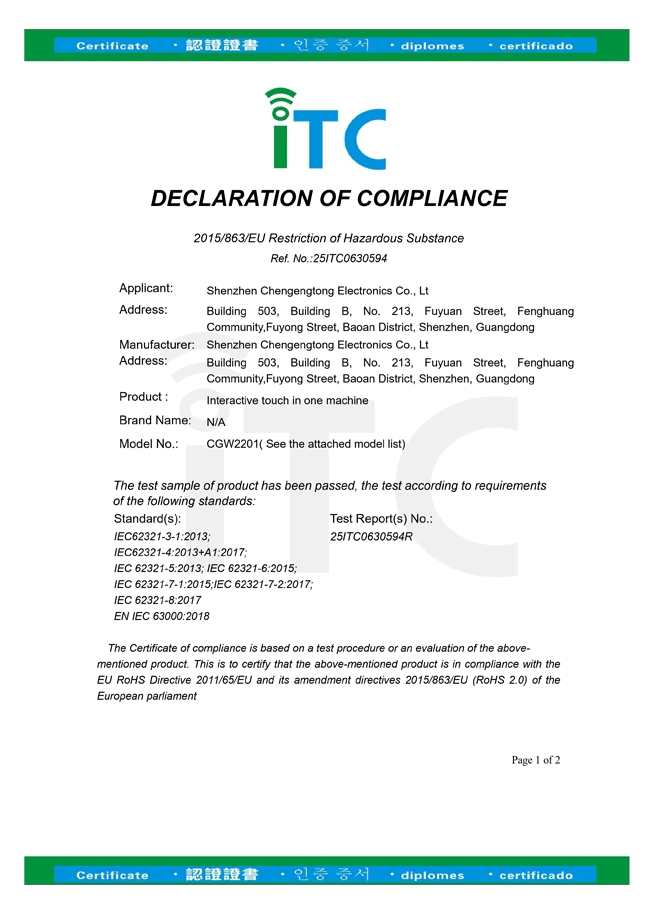
Certificate packs arrive with a commercial display order in three different shapes — and buyers who treat them as one thing usually discover the difference at customs or at an importer's technical review. A conformity mark printed on the rating label, a batch of laboratory test reports, and a supplier's quality management certificate are issued by different bodies for different purposes, and each of them answers a different question. This FAQ sets out what normally travels with an order, what FCC, CE and RoHS each actually cover, where a quality management certificate fits into the picture, what a destination market can require beyond that standard set, which documents are not certificates at all but are still asked for, and how to verify a certificate pack before you rely on it.
The certificate set that travels with a display order
Most display orders of any size end up with six or seven documents. They are worth separating before the enquiry stage, because some of them are produced once for a configuration and others have to be produced for every shipment.
| Document | What it shows | When it is available | Issued by |
|---|---|---|---|
| Conformity mark on the rating label | That the model was assessed against the rules applying in the market where it is placed on sale | From the first production unit | Manufacturer, on the basis of test evidence |
| Declaration of conformity | A signed statement naming the exact model, the standards applied and the person responsible | With the first shipment of a new configuration | Manufacturer |
| Electromagnetic compatibility and safety reports | Measured emissions, immunity and electrical safety results for a named sample | After the sample stage, before mass production | Accredited third-party laboratory |
| Restricted substance report or material declaration | Hazardous substance content of the materials actually used in production | On request, by material or by batch | Laboratory or supplier declaration |
| Certificate of origin | Where the goods were produced, for customs and tariff treatment | With each shipment | Chamber of commerce or trade authority |
| Quality management certificate | That factory processes are audited against a recognised management system | On request, valid for a stated period | Independent certification body |
The important distinction is between the second column and the fourth. A document that names the model and the standards is a product document. A document that names a management system is a process document. Both are useful, but only the first one can be produced to a customs authority or a market regulator when a shipment is questioned.
What FCC, CE and RoHS each cover
These three are grouped together in most enquiries and they are not comparable. One is an emissions rule, one is a declaration across several directives, and one is a substance restriction.
FCC: an emissions rule, not a product approval
In the United States, the FCC rules that touch a display are the radio-frequency emissions limits for digital devices. The practical question for a buyer is which class the unit was tested to. Class A limits are written for commercial, industrial and business environments, while Class B limits are stricter and are written for equipment intended for residential use. A display sold for installation in a store or a control room is normally assessed as Class A, which means that a unit placed in a residential lobby, a clinic waiting room or a hotel where people live and sleep is outside the assumptions of the test. Buyers should confirm the class on the report rather than assume it. The FCC rules, however, do not address electrical safety at all, and many installations are also reviewed by a local authority or an insurer that expects a recognised safety listing from a nationally recognised testing laboratory in addition to the emissions report (Federal Communications Commission, Radio Frequency Devices, retrieved 29 September 2026).
CE: several directives answered with one declaration
CE marking is not a certificate issued by a European body. It is a declaration by the manufacturer that a product meets every directive that applies to it. For a commercial display that normally means the electromagnetic compatibility requirements of Directive 2014/30/EU, the electrical safety requirements of the low voltage Directive 2014/35/EU, the hazardous substance restrictions of the RoHS Directive 2011/65/EU, and the waste handling obligations of the WEEE Directive 2012/19/EU. Where a unit contains a radio module, the radio equipment directive applies in addition. The low voltage directive covers equipment operating between 50 and 1000 volts alternating current, which places mains-powered signage and kiosks inside its scope and leaves low-voltage external power supplies to be assessed under the applicable standard instead. Because the declaration is self-issued, the buyer's protection is the technical file behind it, which the manufacturer must be able to produce on request (EUR-Lex, Directive 2014/30/EU on electromagnetic compatibility, retrieved 29 September 2026; EUR-Lex, Directive 2014/35/EU on low voltage, retrieved 29 September 2026).
RoHS: ten substances and a sample limitation
The RoHS Directive restricts ten substances: lead, mercury, cadmium, hexavalent chromium, polybrominated biphenyls, polybrominated diphenyl ethers, and four phthalates. The concentration limits are 0.1 per cent by weight of homogeneous material for all of them except cadmium, which is limited to 0.01 per cent. The restriction applies to each homogeneous material, not to the finished assembly, which is why a report covering a painted bezel does not cover the gasket behind it (EUR-Lex, Directive 2011/65/EU on hazardous substances, retrieved 29 September 2026). This is also the reason a report is only as good as the sample behind it — a laboratory result confirms the pieces that were submitted, and a buyer who needs coverage of the production materials should ask for a substance declaration from the component suppliers in addition to the report, so that the change of a connector, a cable jacket or an adhesive cannot quietly invalidate the file.
Where a quality management certificate fits
A quality management certificate describes how a factory is run rather than what a product does. It is evidence of controlled documentation, traceability, calibration, corrective action and internal audit. That is genuinely useful to a buyer at three moments: during a supplier audit, when a defect has to be traced back to a batch, and when a repeat order has to match a first order that was approved months earlier. It is not evidence that a display meets an emissions or safety standard, and a buyer who receives one in place of a product report has not received what was asked for. Shenzhen Chengengtong Electronics holds GJB 9001C-2017 weapon equipment quality management system certification, and the factory operates the multi-stage inspection routine described in its export cooperation process, but the compliance documents that a customs authority or a market regulator will look at remain the product test reports and the declaration of conformity.
When the destination market needs more than the standard set
A buyer shipping to more than one country tends to discover that the standard set covers the European Union and the United States and very little else. The table below lists the frameworks most often encountered for display hardware, but the obligation normally sits with the importer of record in the destination country, so the list is a starting point for a conversation with that importer rather than a substitute for it.
| Market | Framework that applies | What to confirm before the order is placed |
|---|---|---|
| European Union | CE marking under Directives 2014/30/EU, 2014/35/EU, 2011/65/EU and 2012/19/EU | Declaration naming the exact model, technical file available, WEEE marking and registration route for the importer |
| Great Britain | UKCA marking | Which mark the importer now requires, since the two are administered separately |
| United States | FCC emissions rules plus a recognised safety listing | Class A or Class B on the report, and whether the authority inspecting the site expects a listing mark |
| Canada | Interference-causing equipment requirements plus a recognised safety listing | Whether the importer holds the registration and which standard the listing was issued against |
| Eurasian Economic Union | EAC conformity under the technical regulations for low voltage equipment and electromagnetic compatibility | Whether a certificate or a declaration is required, and that the importer is the named applicant |
| Saudi Arabia | Registration through the national conformity platform | That the importer has registered the shipment and can obtain the certificate of conformity against the invoice |
| United Arab Emirates | Emirates conformity assessment scheme | Whether the product falls in a regulated category and who registers it |
| Vietnam | National technical regulations for electrical safety, and energy labelling for some categories | That the mains configuration matches the 220 volt 50 hertz supply and whether the category is subject to labelling |
One structural point matters more than any single entry in that table. Certification is normally held against a specific model and a specific electrical configuration. A 55 inch unit and a 65 inch unit of the same family are different models, and a 110 volt variant and a 220 volt variant are different electrical configurations — even when the enclosure is identical. Buyers planning a multi-market rollout should therefore confirm the model list that each certificate covers at the specification stage, because adding a market after production has started usually means paying for a new test round and waiting for its result.
Documents that are not certificates but are still requested
Alongside the compliance pack, every shipment needs a set of commercial documents, and delays at a port are far more often caused by these than by certification. The commercial invoice, the packing list and the bill of lading or air waybill are prepared per shipment. A certificate of origin is normally issued by a chamber of commerce and is what allows a preferential tariff rate or a country-of-origin declaration to be made. Where wooden packing is used, the wood has to carry the international phytosanitary treatment mark, since untreated solid wood packaging is refused at the border in many markets regardless of what the goods are. Classification of the goods falls under heading 8528 of the harmonised system for monitors and display units, with the exact subheading depending on the display technology and whether the unit is able to connect to an automatic data processing machine (World Customs Organization, Trade Tools, retrieved 29 September 2026).
One commercial document deserves to be treated as part of the compliance pack. A serial number list per container, matched to the model and the configuration, is what allows a fault to be traced to a batch later and what allows a warranty claim to be checked without opening the shipment. Buyers who have run a display fleet will ask for it on the first order rather than the second.
How to verify a pack before you rely on it
Before accepting a certificate pack, a buyer can check five things without any technical knowledge. First, that the model number on every document matches the purchase order exactly, including the screen size and any option variant, because a report for a near-identical model is not a report for the shipped model. Second, that the report date falls after the most recent change to the hardware, particularly the mainboard, the power supply or the panel, since a configuration change after testing invalidates the evidence for the changed item. Third, that the issuing laboratory is named and its accreditation and report number can be looked up. Fourth, that the tested sample was a production configuration rather than a hand-built prototype. Fifth, that the whole pack is held under a revision, so that the version attached to a repeat order is the version that was approved. Anything in the pack that cannot be evidenced before the order is better written into the contract as a commitment than assumed.
Applying this to a live project
Shenzhen Chengengtong Electronics produces commercial display hardware across advertising displays and digital signage, industrial and commercial monitors, interactive all-in-one panels and self-service query and payment terminals, covering screen size, brightness class, touch technology, mainboard configuration, interface set, enclosure structure, installation method, logo, packaging and user documentation. The company holds GJB 9001C-2017 weapon equipment quality management system certification and operates a complete R&D, integration, sales and service chain from Bao'an District, Shenzhen.
If your project carries a compliance deadline, the quickest route to an answer is to send the destination market, the model and screen size, the intended installation, and the list of documents your importer has asked for. We will confirm which of them the standard set already covers, which have to be arranged separately for that market, and what the schedule looks like before you commit to a shipment date.